- Empty cart.
- Continue Shopping

Ute Canopy vs Tray vs Tub: The Best Proven Guide
- Posted on
MARC ONEIL
- 0
- Categories: Buyer"s Guide,Ute & 4WD
Ute Canopy vs Tray vs Tub: The Best Proven Guide
Ute canopy vs tray is the decision that determines everything else about your ute — and it gets made badly all the time, usually because the person giving the advice sells only one of the two.
We sell canopies. We also sell toolboxes that bolt onto open trays. So we have no particular reason to push you either way, and we would much rather you bought the right thing once than the wrong thing twice.
Here’s the honest comparison.
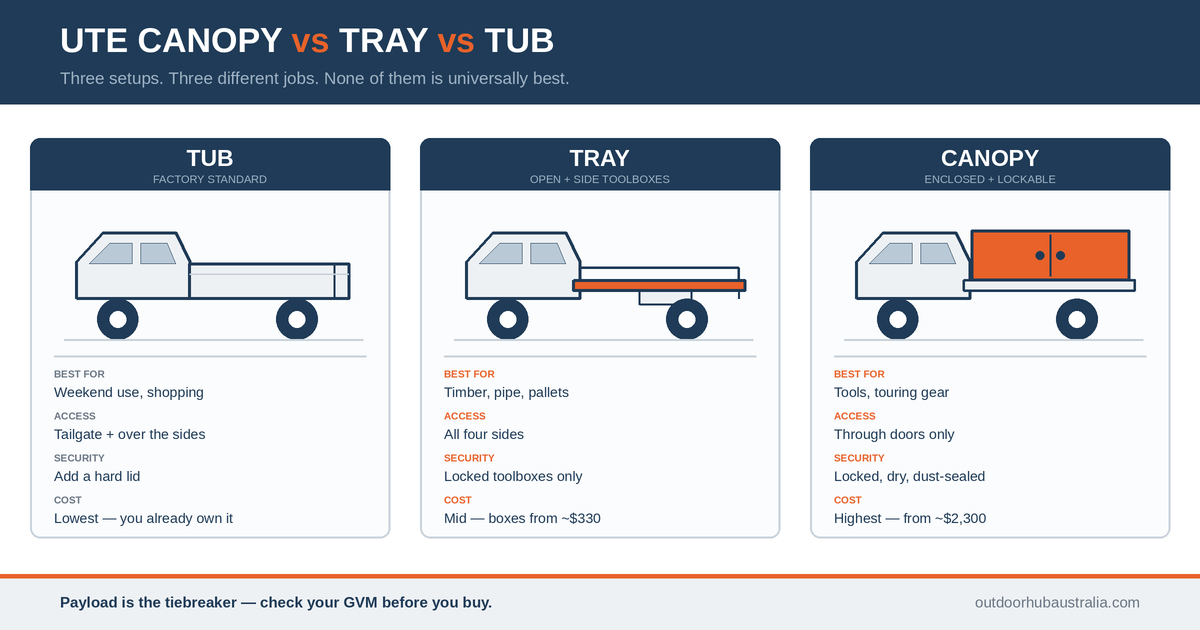
The Quick Answer: Ute Canopy vs Tray vs Tub
If you don’t want to read 2,000 words:
| If you mostly carry… | You want… |
|---|---|
| Tools that need to be locked, dry and organised | Canopy |
| Timber, pipe, pallets, wheelbarrows, ladders | Open tray with side toolboxes |
| The shopping, the dog, occasional gear | Factory tub (add a hard lid) |
| Camping and touring gear, long distances | Tray + canopy — but read the payload section first |
| A bit of everything, and you genuinely can’t decide | Tray + canopy with jack-off legs |
Now the reasoning.
The Three Setups, Defined
The tub is what your ute came with from the factory. Styled to match the cab, with a tailgate and — importantly — wheel arches that intrude into the load space.
The tray is a flat platform that replaces the tub entirely. No walls, no arches, no roof. Just a deck, usually with drop-down or removable sides.
The canopy is an enclosed, lockable box. It can sit on a tub, but it’s most commonly mounted on a tray. It is not an alternative to a tray — it’s something you put on one.
That last point causes most of the confusion in the ute canopy vs tray debate, because it’s a slightly false framing. The real question is: do you want your load space open or enclosed? A tray can be either.
The Factory Tub
Where it wins: it’s free, it’s already there, it looks the way the designers intended, and it keeps your vehicle standard — which some fleets and some resale buyers genuinely prefer. Add a hard lid or tonneau cover and it keeps rain off your gear perfectly well.
Where it loses: the wheel arches steal usable width, the side walls are fixed so you can only load from above or through the tailgate, and it dents. A knock that a tray would shrug off leaves a visible mark on a tub, because a tub is a styled body panel.
Your canopy options are narrower too. Most tub-mounted canopies are lighter, cheaper and less capable than the tray-mounted equivalents.
Converting a tub to a tray is a common and entirely reversible upgrade — keep the tub in the shed and refit it when you sell. Worth knowing if resale is on your mind.
The Open Tray
Where it wins: access, and it isn’t close.
You can load a tray from all four sides. Timber lengths, pipe, star pickets, a wheelbarrow, a pallet dropped on by a forklift — none of that fits through a canopy door, and none of it needs to. Drop the sides and the whole deck is open.
Trays are also tougher and transferable. A quality tray will outlast the ute it’s bolted to, and it comes with you to the next one. That’s a real financial argument that almost never gets made in the ute canopy vs tray discussion.
Pair a tray with side toolboxes and under-tray toolboxes and you get most of the security benefit of a canopy, for a fraction of the weight and cost, while keeping the deck completely clear.
Where it loses: everything on the deck is exposed to weather, dust, UV and anyone walking past. If your gear needs to be dry and locked, a tray on its own doesn’t do it.
The Canopy
Where it wins: security, weather protection and organisation — all at once.
An enclosed, lockable box turns the back of your ute into a mobile workshop or a mobile pantry. Drawers, shelving and dividers mean you stop digging. Tools stay dry. Gear stays put. And in a country where tool theft from utes is a serious and growing problem, a locked canopy is a genuine deterrent.
It also lowers your centre of gravity compared with gear piled on an open deck, which is better for stability.
Where it loses: it is a box, and boxes have doors. The moment you need to carry something that won’t fit through a door, a canopy fights you. Every day. Forever.
It’s also the heaviest and most expensive option — which leads directly to the section that settles the ute canopy vs tray argument for a lot of people.
The Payload Tiebreaker
If you’re genuinely torn, weight will usually break the tie.
Your ute has a GVM — Gross Vehicle Mass — stamped on its compliance plate. Subtract the kerb weight and what remains is your payload: every kilogram you’re legally allowed to add, including passengers and fuel. Most dual cabs land somewhere in the region of 900–1,000kg, but it varies significantly by model and variant. Check your own plate — don’t trust a number from a forum.
Rough figures for the comparison:
| Setup | Approximate weight added |
|---|---|
| Factory tub | ~130–170kg (already counted in your kerb weight) |
| Tray | ~150–250kg — but you remove the tub, so count the difference, not the total |
| Canopy | ~80–200kg on top of the tray |
| Fit-out, drawers, fridge, water, gear | easily another 200–400kg |
A tray-and-canopy build can consume a large slice of your payload before a single tool goes in. That doesn’t make it the wrong choice — it makes it something to plan for. A significant number of touring utes on Australian roads are over their legal GVM, and their owners have no idea until an insurer works it out for them.
Fitting a canopy or a tray is a vehicle modification, and Australia has a national code covering exactly that. It’s worth ten minutes of your time: the Australian Government publishes VSB 14, the National Code of Practice for Light Vehicle Construction and Modification, which sets out the technical requirements for modifying a light vehicle. Broader vehicle standards sit under the Australian Design Rules.
Administrative rules — what needs certifying, and by whom — are set state by state. Victorian owners, for example, should read VicRoads’ guide to modifications for motor vehicles. Check your own state’s road authority before you commit.
Practical advice: get your ute weighed at a public weighbridge, loaded the way you actually use it. It costs very little, and it’s the only honest number you’ll ever get.
What It Costs
Broad strokes, so you can budget:
| Setup | Realistic starting point |
|---|---|
| Factory tub + hard lid | Lowest cost by a wide margin |
| Tray + side toolboxes | Mid — toolboxes from around $330 |
| Tray + canopy | Highest — canopies from around $2,300, plus the tray, plus the fit-out |
The canopy is roughly half the total project cost. Budget for the fit-out from day one, or you’ll end up with an expensive empty box that lets your gear slide around inside it.
The Combinations People Actually Run
Nobody buys “a tray” or “a canopy” in isolation. Here’s what the real setups look like:
- Tub + hard lid. Cheap, standard, weatherproof-ish. Fine for the weekend user.
- Tub + tub canopy. Enclosed storage without fabrication. A compromise, but a legitimate one.
- Tray + side toolboxes. The builder’s, landscaper’s and plumber’s setup. Open deck, locked tools. Badly underrated.
- Tray + canopy. The tradie and tourer standard. Maximum security and organisation.
- Tray + canopy with jack-off legs. Canopy on for work, canopy off for the trailer run. If you truly can’t settle the ute canopy vs tray question, this is the answer — but specify the legs at purchase, because retrofitting them is painful.
- Tray + canopy + under-tray boxes. The full build. Uses the dead space beneath the deck that’s otherwise doing nothing.
Ute Canopy vs Tray: By Use Case
Tradies — and this depends entirely on your trade. Sparkies, mechanics, technicians and anyone carrying expensive, sensitive, organisable tools: canopy. Builders, landscapers, concreters, roofers and anyone carrying long or bulky materials: open tray with side toolboxes. You will hate a canopy. Please don’t let anyone sell you one.
Tourers and campers. Tray plus canopy, aluminium, and an almost obsessive focus on payload. This group goes overweight more often than any other, and by the widest margin.
Farmers and rural users. Usually a tray. You’re loading rough gear from all angles and a canopy just gets in the way. Add a lockable box for the valuables.
Fleets. Standardise. Whatever you choose, choose it once — so keys, gear and training transfer between vehicles.
Weekend users. Keep the tub. Add a hard lid. Spend the difference on something you’ll actually enjoy.
What We’d Tell You If You Rang Us
Two questions settle it.
One: what’s the most awkward thing you carry in a normal month? Not the thing you carry once a year — the normal month. If it doesn’t fit through a door, you want an open tray.
Two: does your gear need to be locked and dry? If yes, you need enclosed storage. That can be a canopy, or it can be toolboxes on an open tray — and for a lot of people, toolboxes are the better answer nobody ever offered them.
If your honest answers are “long timber” and “yes”, you want a tray with side toolboxes, not a canopy. We’d rather tell you that and sell you two toolboxes than sell you a canopy you resent for the next five years.
Shop the Setup You Actually Need
Going enclosed? Browse our ute canopies, including the 1500mm ute canopy and 1800mm ute canopy, plus canopy accessories to fit it out properly.
Staying open? Our ute toolboxes and ute canopy toolboxes give you locked, dry storage while keeping the deck completely clear. The under-tray trundle drawer is the single best use of dead space on a tray.
⚠️ Before you commit: check your ute’s GVM on its compliance plate and make sure your intended build sits inside your payload. Vehicle standards and modification rules vary by state and change over time — verify anything legal or safety-critical with your state road authority or a licensed engineer. This article is general information, not legal, engineering or insurance advice.
Frequently Asked Questions
Ute canopy vs tray — which is better? Neither, because they do different jobs, and a canopy usually sits on a tray anyway. The real question is whether you need your load space open or enclosed. Long or bulky loads: open tray. Tools that must stay locked and dry: canopy.
Can you put a canopy on a ute tray? Yes — that’s the most common setup in Australia. Tray-mounted canopies offer more space and far more options than tub-mounted ones.
Can you put a canopy on a factory tub? Yes, but your options are narrower and tub canopies are generally lighter-duty. The wheel arches also eat into your usable space.
Is a tray heavier than a tub? Usually, but you remove the tub when you fit the tray — so what matters is the difference, not the tray’s total weight. Expect a modest net gain.
Should a tradie get a canopy or a tray? It depends completely on the trade. Sparkies and mechanics: canopy. Builders and landscapers carrying long materials: open tray with side toolboxes. Don’t let anyone sell you a canopy if you carry timber every day.
Can I remove a canopy when I don’t need it? Yes, if it has jack-off legs. Specify them when you order — retrofitting is difficult and rarely worth it.
Is a tray or canopy better for camping? Tray plus canopy, for most people — but payload is the constraint that decides it. Touring builds go overweight more than any other type of build.
Do I need approval to fit a canopy or tray? Fitting a tray or canopy is a vehicle modification. The national technical requirements sit in VSB 14, but the administrative rules — what needs certifying — vary by state. Check with your state road authority before you commit.
Does a canopy or tray affect resale? A quality tray or canopy transfers to your next ute, which is a genuine financial argument in their favour. Keeping the original tub in the shed protects your options either way.
