- Empty cart.
- Continue Shopping




Greenhouse Australia: The Best Proven Buying Guide (2026)
- Posted on
MARC ONEIL
- 0
- Categories: Buyer"s Guide,Greenhouses,Growing
Greenhouse Australia: The Best Proven Buying Guide
Buying a greenhouse in Australia is not the same problem as buying one in England, and almost every guide you’ll read online quietly assumes otherwise.
Here, the enemy is heat. Not frost. A poorly ventilated greenhouse in Adelaide in February will cook everything inside it in an afternoon, and no amount of insulation will save it. Get that one thing right and the rest is straightforward.
This guide covers the four greenhouse types, what they honestly cost in 2026, how to choose by your climate zone rather than by a catalogue photo, and the two failure modes — heat and wind — that ruin more Australian greenhouses than anything else.
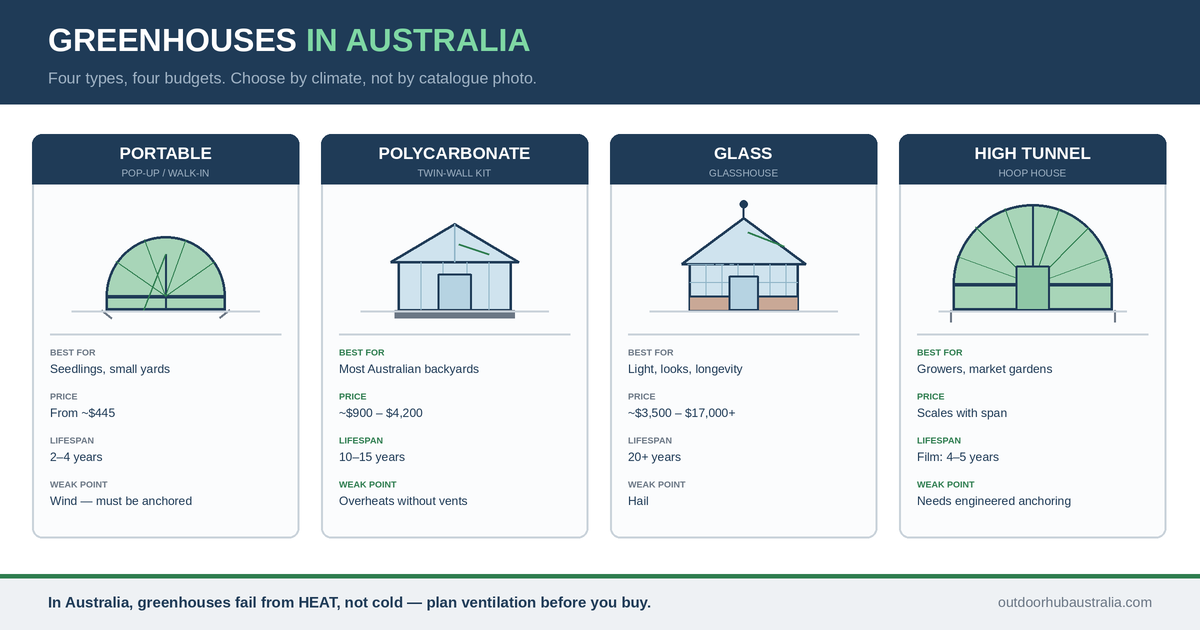
The Four Types of Greenhouse in Australia
Portable / pop-up (from around $445). A frame and a cover. Genuinely useful for hardening off seedlings, protecting a few tomato plants, or testing whether you’ll actually use a greenhouse before spending real money. Lifespan is two to four years, and wind will destroy one that isn’t properly anchored — this is the single most common complaint about them, and it is almost always an anchoring failure, not a product failure.
Polycarbonate kit (roughly $900–$4,200). The default choice for most Australian backyards, and for good reason. Twin-wall panels insulate better than glass, diffuse light evenly instead of creating scorch spots, weigh a fraction of what glass does, and — critically in this country — survive hail that would shatter a glasshouse. Expect 10–15 years before UV degradation shows.
Glass (roughly $3,500–$17,000+). Beautiful, and the best light transmission you can buy at around 90%. Aluminium frames last decades. It is also heavy, expensive, and vulnerable to hail — which is not a hypothetical risk in most of Australia. Buy glass because you want a glasshouse, not because you’ve been told it grows better plants. In practice, the difference is small.
High tunnel / hoop house. For growers rather than gardeners. Cheap per square metre, quick to erect, and easy to scale. Polyethylene film needs replacing every four to five years, and anything of a serious span needs engineered anchoring.
Polycarbonate vs Glass: The Short Version
If you only take one thing from this section: for most of Australia, polycarbonate is the more sensible choice, and the reason is hail.
A severe hailstorm can destroy a glass greenhouse in minutes. Quality 10mm twin-wall polycarbonate will take a hit that shatters glass and keep going. Polycarbonate also insulates better (the air gap does the work), diffuses light so you get no hot spots, and weighs roughly a tenth of what glass does — which makes DIY assembly realistic.
Glass wins on light transmission, on clarity, and on lifespan. If you’re in a low-hail area, you want the look, and the budget is there, it’s a lovely thing to own.
Thickness, briefly: 4–6mm twin-wall for mild climates and seasonal use; 10mm for year-round growing or anywhere with weather. We’ve covered the full comparison — light transmission, R-values, cost per square metre, UV yellowing — in our dedicated polycarbonate vs glass guide.
What Size Greenhouse Do You Need?
The universal regret in this category is “I should have gone bigger.” We hear it constantly, and we’d rather tell you now than sell you the wrong thing.
A greenhouse fills up faster than anyone expects. Benches take space. Walkways take space. Then you want a second bench. As a rule of thumb: work out the size you think you need, then buy one size up. The marginal cost of going bigger is far smaller than the cost of replacing a greenhouse you’ve outgrown in two seasons.
Rough starting points:
- 6×8ft — seedlings, herbs, a few pots. One person, standing room, not much else.
- 8×12ft — the sweet spot for a serious home gardener. Benches down both sides, room to work.
- 10×12ft and up — raised beds inside, tall crops, year-round production.
Height matters too, and gets ignored. Tomatoes and cucumbers grow up. A low-eave greenhouse limits what you can grow before you’ve planted anything.
Choose by Climate Zone, Not by Catalogue
This is where most Australian greenhouse buyers go wrong. A greenhouse that works beautifully in Hobart is the wrong purchase in Cairns, and vice versa.
Australia spans six major climate zones. Before you buy, find yours on the Bureau of Meteorology’s climate classification maps — it takes two minutes and it will change what you buy.
Tropical and subtropical (far north QLD, NT, northern WA). Your problem is heat and humidity, not cold. You may not need a greenhouse at all — you may need a shade house. If you do build one, ventilation and shade cloth matter more than glazing.
Temperate (Sydney, Melbourne, Perth, Adelaide). The mainstream case. A polycarbonate kit with good roof vents and summer shade cloth will serve you year-round. Heating is rarely worth the running cost.
Cool and alpine (Tasmania, the highlands, NZ South Island). The only part of the region where heating genuinely earns its keep. Go thicker on the glazing — 10mm twin-wall minimum — and consider thermal mass before you consider a heater.
Arid (inland). Extreme heat, extreme diurnal swing, wind. Shade, ventilation and anchoring are all non-negotiable.
The Heat Problem: Australia’s Real Greenhouse Killer
Read this section even if you skip the rest.
The number one cause of greenhouse failure in Australia is not frost. It is heat. Every northern-hemisphere greenhouse guide is written to solve the opposite problem, and following that advice here will cook your plants.
A sealed greenhouse in an Australian summer can climb 20°C or more above ambient. At 45°C, most plants stop growing. Above that, they die.
What actually works:
- Roof vents totalling at least 20% of the floor area. This is the single most important spec on the entire product page, and it’s the one nobody checks. If a greenhouse doesn’t tell you its vent area, ask.
- Automatic vent openers. Wax-piston units need no electricity and open on temperature alone. Cheap. Buy them.
- Shade cloth over the glazing in summer. 30–50% for most crops. Our shade material range covers this.
- Cross-flow ventilation. Vents at both ends, low and high, so hot air can actually leave.
- Damping down — wetting the floor on hot mornings — costs nothing and works.
Get ventilation right at purchase. Retrofitting vents into a greenhouse you already own is possible but miserable.
Wind and Anchoring: The Other Failure Mode
The second-biggest cause of destroyed greenhouses is wind uplift, and it’s almost always an anchoring failure rather than a structural one.
A greenhouse is, aerodynamically speaking, a very large kite. It needs to be tied down to something that isn’t going anywhere. A base kit, a concrete slab, a paver perimeter or ground anchors — the method matters less than the fact that there is one.
For New Zealand buyers this is a formal, regulated question, not a rule of thumb. NZ classifies sites by wind zone — low, medium, high, very high and extra high — under NZS 3604. If you’re on a coastal or exposed site, this determines what you can legally and safely build. Start with MBIE’s guidance on using NZS 3604, and BRANZ’s practical walkthrough of how to find your wind zone. A hobby greenhouse rated for a sheltered Melbourne backyard is not the right structure for an exposed site in Wellington or Southland.
Australian buyers on coastal or exposed sites should apply the same logic even where it isn’t formally required — and anyone building something substantial should be looking at an engineered structure, not a hobby kit.
Do You Need Council Approval?
Usually not for a domestic backyard greenhouse — but usually is doing a lot of work in that sentence.
Most states have exempt-development rules that let you put up a small structure without approval, subject to floor area, height and boundary setback limits. Those thresholds vary by state and by council, and they change.
Broadly, the things that push you into needing approval are: floor area above the exempt threshold, height, proximity to a boundary, being in a heritage or bushfire overlay, or anything with a concrete slab and services.
Check with your local council before you buy, not after it’s delivered. We’ve covered the state-by-state thresholds in a dedicated guide, but a five-minute phone call to your council beats any article on the internet, including ours.
Greenhouse Prices in Australia: Real Numbers
Most greenhouse retailers hide their pricing. Here’s ours, so you can budget honestly.
| Type | Example | Price |
|---|---|---|
| Portable / pop-up | 10×20 Peak Style Greenhouse | $444.89 (was $717) |
| Compact polycarbonate | Patio Gardenhouse | $835 |
| Mid polycarbonate | Mythos Greenhouse | $900 (was $1,439) |
| Larger kit | Grow-It Peak, 12ft wide | $899 – $999 |
| Premium hybrid | Legacy Greenhouse, 8×8 glass & poly | $3,579.69 (was $6,184) |
| Glass, ornamental | Junior Victorian Greenhouse | $4,199.99 (was $7,800) |
| Large glasshouse | Riga XL Greenhouse | $15,499 – $20,698 |
| Bespoke / heritage | Gabriel Ash Rosemoor | $16,850 |
Budget beyond the greenhouse itself. A base or foundation, shade cloth, an automatic vent opener and benching will typically add 15–30% to the sticker price. Plan for it now rather than discovering it in week two.
What to Grow in an Australian Greenhouse
The honest answer: a greenhouse doesn’t let you grow anything — it lets you grow things earlier, later, and more reliably.
- Seed raising. The best possible use. Start six to eight weeks ahead of the open garden. Add a heat mat and you can start earlier still.
- Tomatoes, capsicum, chilli, eggplant, cucumber. Warm-season crops that reward the extra heat and the wind protection.
- Leafy greens through winter. Lettuce, rocket, spinach, Asian greens — a greenhouse turns these from a struggle into a certainty in most of the country.
- Frost-tender perennials. Citrus in pots, orchids, tropicals in temperate zones.
What a greenhouse won’t fix: poor light, poor soil, or poor watering. It amplifies whatever you’re already doing.
Where a Greenhouse Isn’t the Answer
An honest guide has to say this.
If you’re in the tropics, you may want a shade house, not a greenhouse. Adding heat to Cairns is not the problem you have.
If you want to grow a few herbs, a cold frame or a sunny windowsill will do it for a fraction of the money.
If your yard is windy and you won’t anchor properly, don’t buy a portable greenhouse. It will end up in your neighbour’s yard, and that’s not a manufacturing defect.
And if you can’t commit to ventilation — vents, shade cloth, opening doors on hot days — a greenhouse will kill more plants than it saves. That is not a scare tactic. It’s the most common reason people give up on them.
Shop Greenhouses and Growing Structures
Browse our full range of greenhouses and growing structures — from the $444 Grow-It portable through polycarbonate kits like the Mythos and Patio Gardenhouse, up to engineered glasshouses.
Fitting one out? See our climate control range for heating and thermostats, shade material for summer, and hydroponics if you’re growing without soil.
⚠️ Before you buy: confirm your local council’s rules on exempt structures, and check the wind exposure of your site. Building and planning rules vary by state, territory and council in Australia, and by council and wind zone in New Zealand — and they change. This article is general information, not planning, engineering or legal advice. Confirm anything structural or regulatory with your council or a qualified engineer.
Frequently Asked Questions
What is the best greenhouse in Australia? For most backyards, a polycarbonate kit with adequate roof venting. It handles hail, insulates well, diffuses light, and costs a fraction of glass. Glass is the better choice only if you’re in a low-hail area and you want the look.
How much does a greenhouse cost in Australia? Realistically from around $445 for a portable, $900–$4,200 for a polycarbonate kit, and $3,500–$17,000+ for glass. Budget another 15–30% for the base, shade cloth, vents and benching.
Polycarbonate or glass? Polycarbonate for most of Australia — hail resistance and insulation win. Glass for light transmission, appearance and longevity, if hail isn’t a serious risk where you are.
Do I need council approval for a greenhouse? Usually not for a small domestic structure, but thresholds for floor area, height and boundary setbacks vary by state and council. Ring your council before you buy.
What size greenhouse should I get? Bigger than you think. Work out what you need, then go one size up. Almost nobody regrets it; plenty of people regret going small.
Why does my greenhouse get so hot? Because it’s a greenhouse, in Australia, and it probably doesn’t have enough ventilation. You want roof vents totalling at least 20% of the floor area, automatic vent openers, and shade cloth in summer.
Will a greenhouse survive strong wind? Only if it’s anchored. Wind uplift destroys more greenhouses than anything else. Use a base kit, slab, or ground anchors. In New Zealand, check your wind zone under NZS 3604 first.
Can I use a greenhouse in the tropics? You may want a shade house instead. In tropical and humid climates, the problem is excess heat, not insufficient heat.
What can I grow in a greenhouse in winter? Leafy greens, herbs, and Asian greens do well across most of Australia and NZ without heating. Heating only becomes worthwhile in cool and alpine zones.
