- Empty cart.
- Continue Shopping

Polycarbonate vs Glass Greenhouse: Best Proven Guide 2026
- Posted on
MARC ONEIL
- 0
- Categories: Buyer"s Guide,Greenhouses,Growing
Choosing between a polycarbonate vs glass greenhouse is the single biggest decision you’ll make when buying, and almost every guide answering it was written for the northern hemisphere — where the weather is a completely different problem.
In Australia, one factor settles the polycarbonate vs glass greenhouse argument for most buyers, and it isn’t light transmission, insulation or cost. It’s hail.
Here’s the honest comparison, with the trade-offs left in.
Polycarbonate vs Glass Greenhouse: The Short Answer
For most of Australia, buy polycarbonate. It survives hail that would destroy a glasshouse, it insulates better, it diffuses light so your plants don’t scorch, it weighs a fraction of glass, and it costs less.
Buy glass if you’re in a low-hail area, you want the look of a proper glasshouse, and the budget is there. It transmits more light, lasts longer, and it’s a genuinely beautiful thing to own.
That’s the whole answer. The rest of this guide is why.
Hail: The Argument That Settles It
This is the section that matters, and it’s the one every overseas guide leaves out.
Australian hail is not a minor risk. According to the Bureau of Meteorology, hailstone diameter can range from 5mm to more than 100mm — and a hailstone measuring 160mm was recorded at Yalboroo in Queensland in October 2021. The Bureau warns for “large hail” at 2cm and above, roughly the size of a $2 coin.
A $2 coin falling at terminal velocity will crack horticultural glass. Cricket-ball hail will destroy an entire glasshouse in under a minute.
Quality 10mm twin-wall polycarbonate takes that hit and keeps going. It’s the same material used in machine guards and riot shields. This is not a marginal advantage — it is the difference between a greenhouse that survives a storm and a greenhouse that becomes a pile of broken glass with your seedlings underneath it.
If you take one thing from this polycarbonate vs glass greenhouse comparison, take this: in most of Australia, glass is a bet on the weather. Polycarbonate isn’t.
Light Transmission: Glass Wins, But Less Than You’d Think
Glass transmits roughly 90% of available light. Twin-wall polycarbonate manages around 80–85%. On paper, glass wins.
In practice, the gap matters far less than the numbers suggest — and in Australia it can actually work against you.
Glass transmits direct light. That creates hot spots, and hot spots scorch leaves. Polycarbonate diffuses light, spreading it evenly through the structure and reaching the lower leaves that direct light never touches. In a country with the light levels we have, diffusion is often the more useful property.
The honest verdict: if you’re growing in a dim, overcast climate, that extra 5–10% of light is genuinely valuable. In Australia, you are not short of light. You are short of shade.
Insulation: Polycarbonate, Comfortably
Twin-wall polycarbonate has an air gap between its two layers, and that trapped air is what does the insulating. Single-pane glass has nothing.
The practical effect: a polycarbonate greenhouse holds overnight warmth better and loses less heat through the glazing. For anyone in a cool zone — Tasmania, the highlands, the New Zealand South Island — this materially reduces what you’d otherwise spend on heating.
Thicker means warmer. Multiwall panels with three or more layers add more air chambers and further reduce heat loss. The trade-off is a small reduction in light transmission and a higher price.
UV and Lifespan: Where Glass Fights Back
Here’s the strongest argument against polycarbonate, and we’re not going to hide it.
Australia has some of the highest ultraviolet levels on earth. The Australian Radiation Protection and Nuclear Safety Agency publishes real-time data on ultraviolet radiation in Australia, and the levels are punishing — for skin, and for plastic.
Polycarbonate is a plastic. Over time, UV degrades it: it yellows, it clouds, it loses light transmission, and eventually it becomes brittle. UV-stabilised panels resist this, but they don’t defeat it. Expect 10–15 years in most of Australia, and toward the shorter end in high-UV regions.
Glass doesn’t care about UV. A glasshouse pane will be optically identical in 40 years. Aluminium frames routinely outlast their owners.
So the real lifespan question is: what’s more likely to end your greenhouse — twelve years of UV, or one bad hailstorm? For most Australians, honestly, it’s the hailstorm.
One practical note: when you buy polycarbonate, check the panels are UV-coated on one side and install that side facing out. Fitting the panels upside down is a surprisingly common mistake, and it halves their working life.
Weight, Assembly and Cost
Polycarbonate weighs roughly 3kg per square metre. Horticultural glass is around 25kg per square metre — very roughly eight times heavier.
That difference cascades through the entire project:
- Frame — glass needs a heavier, stronger structure to carry it.
- Foundation — more weight, more base.
- Assembly — polycarbonate is a genuine one-person DIY job. Glass usually isn’t, and dropping a pane is expensive.
- Delivery — glass is fragile and heavy, which shows up in freight.
- Repairs — a cracked polycarbonate panel is a cheap swap. A broken glass pane is a trip hazard and a bill.
Upfront cost follows the same pattern. Polycarbonate kits start around $900 and run to roughly $4,200. Glass and hybrid glasshouses start around $3,500 and climb past $17,000 for bespoke heritage structures.
What Thickness of Polycarbonate Do You Need?
If you’ve settled the polycarbonate vs glass greenhouse question in favour of polycarbonate, thickness is your next decision — and it depends entirely on your climate.
Find your climate zone on the Bureau of Meteorology’s climate classification maps before you choose. It takes two minutes.
- 4mm twin-wall — mild climates, seasonal use, budget builds. Thin, and it shows in cold weather.
- 6mm twin-wall — the common middle ground. Fine for most temperate backyards.
- 10mm twin-wall — the right answer for year-round growing, cool and alpine zones, exposed sites, and anywhere with serious hail. This is what we’d recommend to most people who intend to use the greenhouse properly.
- Multiwall (3+ layers) — heated greenhouses, Tasmania, alpine, NZ South Island. Lowest heat loss available.
Corrugated single-wall polycarbonate is a different product — cheap, no insulation, fine for cold frames and simple shelters, wrong for a greenhouse you plan to use in winter.
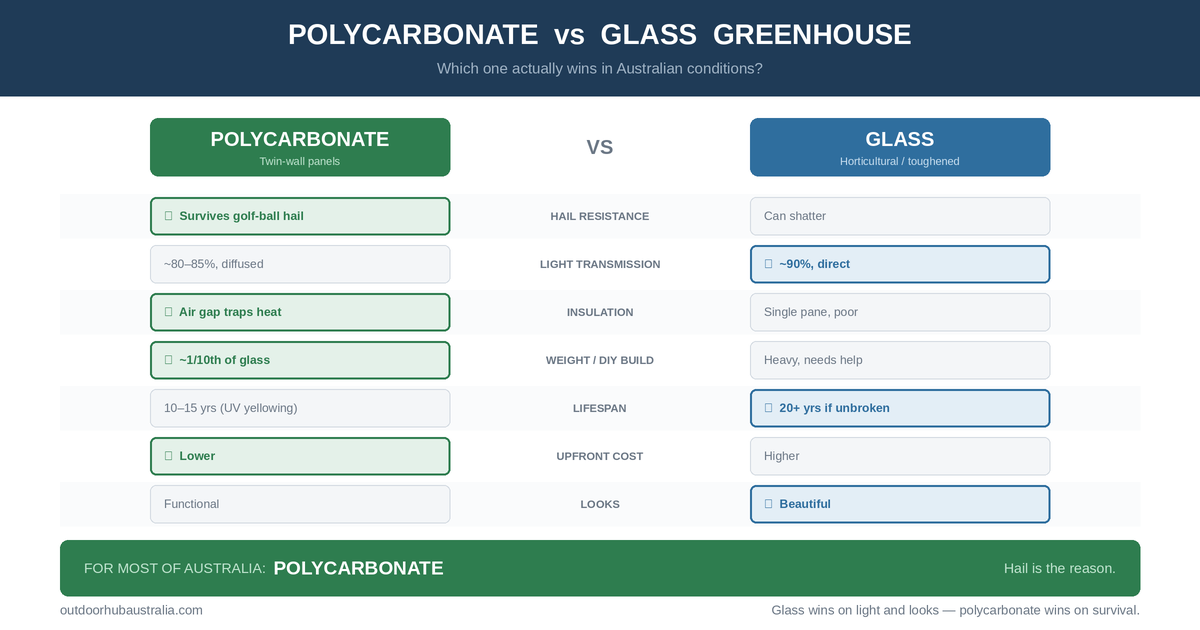
Polycarbonate vs Glass Greenhouse: The Full Comparison
| Factor | Polycarbonate | Glass | Winner |
|---|---|---|---|
| Hail resistance | Survives golf-ball hail | Can shatter completely | Polycarbonate |
| Light transmission | ~80–85%, diffused | ~90%, direct | Glass |
| Light quality | Even, no scorch spots | Direct, creates hot spots | Polycarbonate |
| Insulation | Air gap traps heat | Single pane, poor | Polycarbonate |
| Weight | ~3kg/m² | ~25kg/m² | Polycarbonate |
| DIY assembly | One-person job | Needs help, needs care | Polycarbonate |
| Lifespan | 10–15 years (UV yellowing) | 20+ years if unbroken | Glass |
| Upfront cost | From ~$900 | From ~$3,500 | Polycarbonate |
| Repairs | Cheap panel swap | Expensive, hazardous | Polycarbonate |
| Appearance | Functional | Beautiful | Glass |
When Glass Is Genuinely the Right Choice
We sell both, so let us make the case for glass properly rather than pretending it doesn’t exist.
Buy glass if you’re in a low-hail area. Coastal Perth, much of Tasmania, parts of Victoria. Check the risk where you actually live rather than assuming.
Buy glass if the greenhouse is a garden feature, not just a growing tool. A Victorian glasshouse is architecture. A polycarbonate kit is a shed with better light. If you want to look at it as much as you want to grow in it, this matters — and there’s nothing wrong with that being your reason.
Buy glass if you’re growing light-hungry crops through a dim winter and every percentage point of transmission counts.
Buy glass if you want it to outlive you. Properly built glasshouses become inherited objects. Polycarbonate doesn’t.
Our Honest Recommendation
If you asked us over the counter to settle the polycarbonate vs glass greenhouse question once and for all, here’s what we’d say.
Most people should buy a 6mm or 10mm twin-wall polycarbonate greenhouse. It’s the right answer for the overwhelming majority of Australian and New Zealand backyards: it handles our weather, it insulates, it’s affordable, and you can put it up yourself on a weekend.
Go 10mm if you can afford the step up. Better insulation, better hail resistance, better everything. The price difference is smaller than the regret.
Buy glass with your eyes open. It’s the more beautiful object and the better long-term structure — provided the hail doesn’t find it. Some people make that trade knowingly and happily. Just make it knowingly.
What we’d rather you didn’t do is buy a glasshouse because a website told you glass “grows better plants.” In Australian conditions, that’s not really true, and it’s an expensive thing to be wrong about.
Shop Greenhouses
Browse our full range of greenhouses and growing structures — polycarbonate kits including the Mythos Greenhouse ($900, was $1,439) and the Patio Gardenhouse ($835), the glass-and-polycarbonate hybrid Legacy Greenhouse ($3,579), and glasshouses from the Junior Victorian ($4,199) up to the Riga XL.
Whichever glazing you choose, you’ll want shade material for summer — because in Australia, heat kills more greenhouse plants than cold ever does.
Before you buy: check hail risk and wind exposure at your specific site, and confirm your local council’s rules on exempt structures. Building and planning requirements vary by state, territory and council in Australia, and by council and wind zone in New Zealand, and they change. This article is general information — not planning, engineering or legal advice.
Polycarbonate vs Glass Greenhouse: Frequently Asked Questions
Polycarbonate or glass — which is better for a greenhouse in Australia?
Polycarbonate, for most people. It survives hail, insulates better, diffuses light and costs less. Glass wins on light transmission, appearance and lifespan, and is a good choice in low-hail areas.
Does polycarbonate really survive hail?
Quality 10mm twin-wall polycarbonate withstands impacts that shatter glass. Given the Bureau of Meteorology records hailstones over 100mm in Australia, this is a serious practical advantage, not a marketing claim.
How long does polycarbonate last before it yellows?
Typically 10–15 years with UV-stabilised panels, and toward the shorter end in high-UV regions. Install the UV-coated side facing outward — fitting panels the wrong way round dramatically shortens their life.
What thickness of polycarbonate should I use?
4–6mm for mild climates and seasonal use. 10mm for year-round growing, cool climates, exposed sites, or serious hail risk. If in doubt, go thicker.
Does glass grow better plants than polycarbonate?
Not meaningfully, in Australian conditions. Glass transmits about 5–10% more light, but it’s direct light that creates scorch spots. Polycarbonate’s diffused light reaches lower leaves more evenly. Light is rarely the limiting factor here.
Is polycarbonate cheaper than glass?
Yes — usually substantially. Polycarbonate kits start around $900; glass greenhouses start around $3,500 and go well past $17,000.
Can I replace glass panels with polycarbonate?
Often yes, and it’s a common retrofit after hail damage. Check that your frame’s glazing channels suit the panel thickness before ordering.
Which is better for a hot climate?
Polycarbonate — the diffused light reduces scorching and the insulation moderates temperature swings. But in any hot climate, ventilation and shade cloth matter far more than your choice of glazing.
